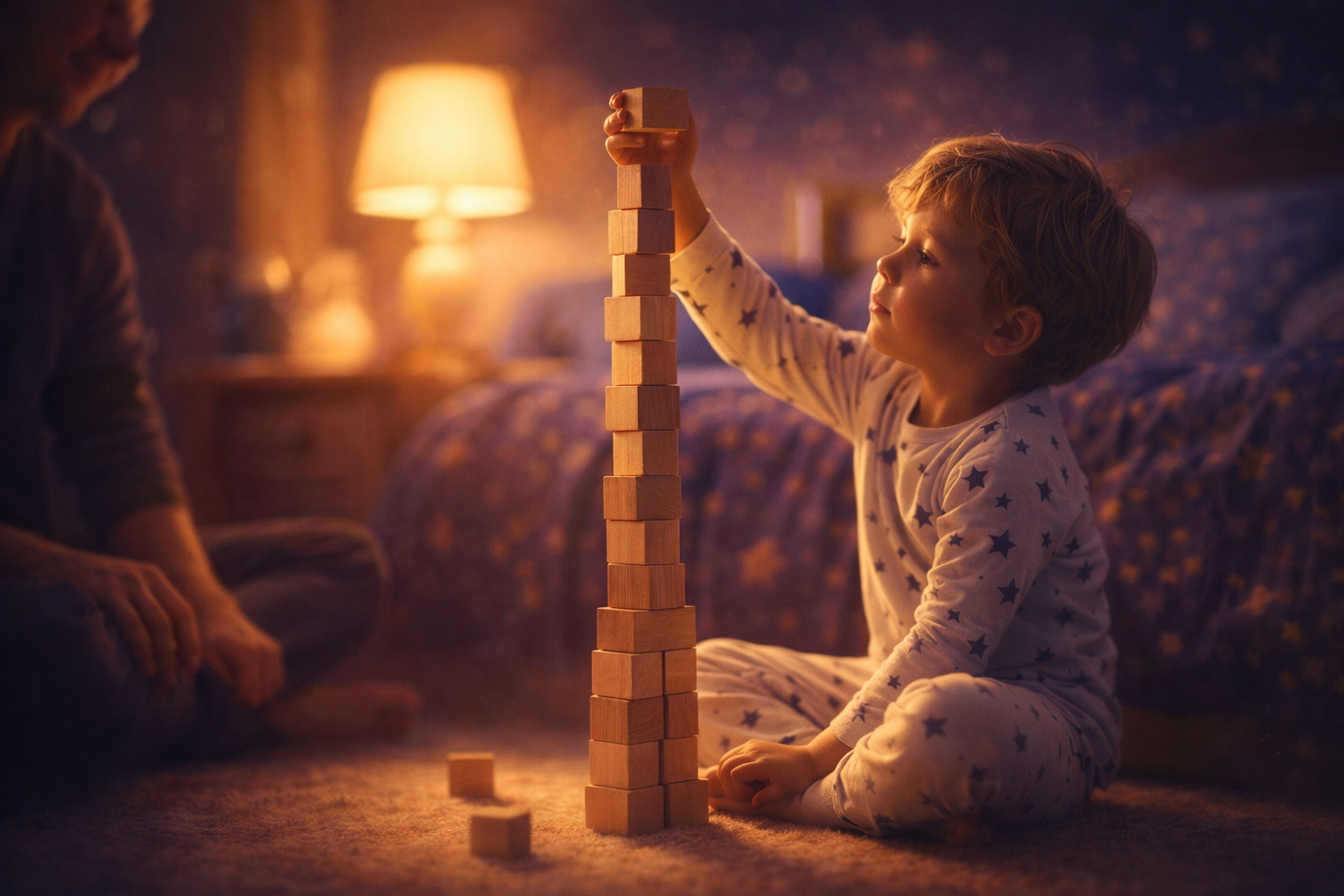
You've read it fourteen times. You know every page before you turn it. You've started doing the voices without thinking. Your child asks for it again tonight and some small part of you wants to hide it behind the radiator.
This is the experience of almost every parent of a young child, with almost every book that ever captured a child's attention. The repetition feels endless from the outside. But from the child's perspective, something genuinely different is happening each time — and the research on why is more interesting than you might expect.
What children are actually doing when they repeat
Adults tend to read a story to find out what happens. Once we know, the story is finished. A child doesn't work this way. They already know what happens. That's the point.
A 2011 study by Cristine Legare at the University of Texas looked at how children use repetition to understand causality — why things happen, not just what happens. When a child already knows the plot, they can stop tracking the narrative and start paying attention to everything else: the language, the rhythm, the relationship between cause and effect in the story, details they missed the first ten times.
Repetition accelerates language development
A 2014 study by Jessica Horst at the University of Sussex found that children learn new words significantly faster from repeated readings of the same book than from single readings of multiple different books. After three reads of the same story, children retained new vocabulary at nearly twice the rate of children who heard the same words in three different stories.
The reason is consolidation. Each time through, the child already knows the story structure, so their working memory has spare capacity. That capacity goes toward encoding unfamiliar words more deeply — connecting them to context, emotion, and the specific moment in the story where they appeared.
A separate study by Trivette, Dunst and Gorman (2010) confirmed that repeated shared reading produced more child initiations — questions, comments, pointing — than first-time readings. Children are more active, not more passive, on repeated exposure.
The parent experience vs the child experience
The mismatch here is real and worth naming. Parents find repetition tedious because adult cognition is novelty-seeking. We are wired to find new information more stimulating than familiar information. We scan for what's changed, what we don't yet know. A story we've read fourteen times offers nothing new.
Young children's cognition works differently. Under about age six, children's brains are still building the basic schemas they need to understand the world — categories, sequences, cause and effect, how language maps onto meaning. Familiar material isn't boring to a brain that's still working out how things fit together. It's useful.
What the parent experiences
- The outcome is already known
- The language is entirely familiar
- No new information is processed
- Attention drops, boredom rises
- Goes on autopilot to get through it
What the child is doing
- Predicting what comes next — and being right
- Consolidating new vocabulary from earlier reads
- Noticing details missed before
- Feeling competent and in control
- Using the story as a familiar, safe place
That last point matters more at bedtime than at any other time. Repetition at the end of the day isn't just about cognitive development. It's about how a child's nervous system reads the familiar as safe.
Repetition as a safety signal
Young children can't regulate their own stress responses. They rely on their environment — and the predictable people in it — to do that for them. A story they know is a story where nothing goes wrong unexpectedly. The bear comes back. The rabbit finds his way home. The ending is always the same. A child who asks for the same story every night isn't bored of novelty. They're using the story to tell their nervous system that the world is still in order.
This is why the same book, at the same point in the bedtime routine, works better as a sleep aid than a different book every night. Variety has its place, but not at 7:30pm when the goal is to lower cortisol and get a child to sleep. The familiar is faster.
Children who have a favourite repeated story often begin to "read" it themselves before they can actually read. They have memorised the words from repeated hearings and recite them as they turn the pages. This is called emergent literacy, and it's one of the precursors to learning to decode written language. The repetition created it.
Parents sometimes worry this is just memorisation rather than reading. It isn't — or rather, it isn't just memorisation. The child is learning that text maps onto sound, that words have consistent shapes, that stories have structure. The same structure, reliably, repeated. That's how they learn it.
Why "one more time" means something different
When a child says "again" at the end of a story, they're not making a demand for entertainment. For a child under five, the request is closer to: confirm that this still works. That the story still ends the same way. That you're still here. That I can still predict what happens.
Children going through change — a new sibling, a house move, starting nursery — often intensify their attachment to particular repeated stories. The research on this is consistent: in periods of stress or adjustment, children return to the familiar. Not because they've run out of other options, but because familiarity is doing specific work for them.
"Again" isn't boredom. It's a child who found something that works and wants to keep it.
At what point should you introduce new stories?
The honest answer is: when the child asks. Most children naturally reach a saturation point with a particular story — usually after weeks or months, not days. The request for "the same one" gradually becomes "that one or this one" and then "actually can we try this?" You don't need to engineer the transition.
What you can do is make new stories feel as safe as the familiar ones. The most effective way to do this, according to Horst's research, is to introduce a new book three times in close succession before rotating it out. Three reads is roughly when a child moves from novelty-tracking to consolidation. After that, a new story starts to feel like an old one.
This is one reason children who use Dreamland tend not to resist new stories the way they might resist new books. Each story is new in plot but identical in structure — same character, same world, same voice. The novelty is contained within a familiar frame. The child gets a new adventure without losing the things that made them feel safe in the first place.
The short version, for 7:30pm on a Friday
Your child asking for the same story again is not a failure of their imagination or yours. It means they found a story good enough to return to, which is more than most adults manage with most books.
The research says: let them. The language acquisition, the emotional regulation, the emergent literacy — all of it runs on repetition. You being bored is the side effect of something that is working.
If you're the one reading aloud and the repetition is genuinely wearing you out, try varying your delivery rather than the story. Different voices, different pacing, pausing to ask the child what comes next. Children enjoy this — it turns them into the expert. You get some variety. The story stays the same, which is what they actually need.
A new adventure every night — in a world they already know
Dreamland gives your child a fresh story in their familiar world, with their own character, every single night. New enough to be interesting. Familiar enough to feel safe.
Join the waitlist